



Flamengo presents technical diagnosis and new project for the Gasômetro stadium
Bap and FGV detail inconsistencies in the previous plan and present a realistic proposal for costs, deadlines, and financing to make the stadium viable.
By Communication - inOn the evening of this Wednesday (17/09), the president of Flamengo, Luiz Eduardo Baptista, Bap, presented to the Deliberative Council, together with Alexandre Rangel, partner at RRA Consultoria, and Ricardo Simonsen, Henrique Castro and Bauer Rachid, from FGV Conhecimento, the conclusions of the field studies of surveys, arboreal, topography, historical heritage and decontamination of the land of the Gasômetro Stadium, carried out by five contracted companies.
The current administration's work, which began seven months ago, was fundamentally based on enabling the construction of its own stadium without the club becoming a SAF (Soccer Association) and without compromising its sporting performance. To this end, measures were adopted such as the creation of a dedicated project management team, the rehiring of Arena—responsible for the initial project—for technical support, the conduction of a feasibility study by FGV, in-depth site analyses, the resolution of outstanding issues with the AGU (Authority of Sporting Goods), City Hall, and Naturgy, and the evaluation of stadium alternatives.
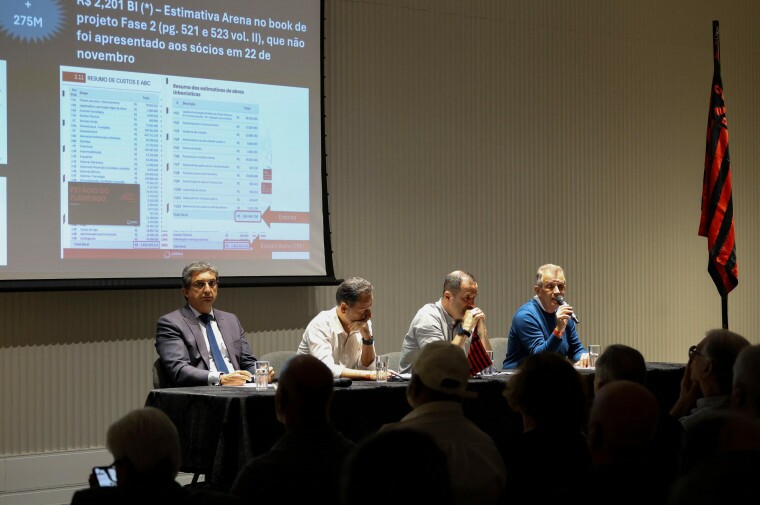
During this period, a team of experts dedicated themselves to developing a viable project, correcting original distortions that involved underestimated costs, unrealistic deadlines, overestimated revenues, and an unsustainable financing model.
Ricardo Simonsen, technical director, and Henrique Castro, economics professor at FGV EESP, detailed how costs were underestimated in the proposed project. FGV calculated the final cost, adjusting for inflation, contingencies, and inputs, at R$2,66 billion. Including the capital cost, the stadium's total value is R$3,1 billion. The value presented by the previous administration in the budget proposal was R$1,9 billion.
Furthermore, projected revenues were overestimated. According to FGV's analysis, the plan assumed an average ticket price of R$195,44—more than double the current average—with 30% of seats classified as VIP or Premium, double the current number at Maracanã. A complex and elite stadium was planned. Sponsorship costs of R$60 million and the anticipated revenue from naming rights were also inflated. Furthermore, the CPACs' values, initially estimated at R$552 million, were recalculated by FGV to R$194 million.
The deadlines were also revised. The original schedule ignored essential steps, such as the relocation of Naturgy, which currently occupies 55% of the land, with a gas pumping substation for the Rio de Janeiro metropolitan region. According to the statement Naturgy sent to Flamengo on September 10, 2025, the estimated relocation time is four years, after a new location for the substation is obtained, which is the responsibility of the City Hall.
According to Aecom, the company hired to plan the decontamination strategies, 21 public studies demonstrate the complexity of the site's contamination, making the five-month decontamination deadline proposed in the 2024 plan unrealistic. Furthermore, FGV's preliminary report pegged a decontamination deadline of between 18 and 24 months, after Naturgy's departure. Without this step, it is impossible to obtain the necessary permits to begin construction.
In practice, this means that work could not begin in less than six to seven years, to which would be added another three years of construction — projecting the stadium's delivery from 2034 onwards, which makes the December 2029 opening date predicted by the previous administration completely unrealistic.
To make the stadium viable, experts from FGV and Arena presented a proposal for a new project, based on more realistic premises and with a more popular profile and identification with Flamengo.
• Optimized 72-seat stadium, focusing on reducing premium seating
• Revised cost of R$2,2 billion, including the stadium, contingencies, land, capital cost and surrounding cost.
• Minimum completion date in July 2036, depending on various external factors.
• Viable financing strategy based on the generation of internal resources (savings).
• Support for increased budget revenue and profitability, without impacting sports performance.
Before closing the meeting, President Bap outlined the next steps. In the short term, the focus will be monitoring Naturgy's relocation process with City Hall, demolishing and clearing the land under Flamengo's responsibility, monitoring legislative approval of the CPACs, and signing the Definitive Agreement with the AGU, Caixa Econômica Federal, and City Hall. In the medium and long term, the priority will be structuring the executive project for the stadium's construction.
