



Flamengo inaugurated "Walls of Gávea" this Saturday, on its anniversary.
Open-air exhibition is part of the 130th anniversary celebrations.
By Flamengo Communication - in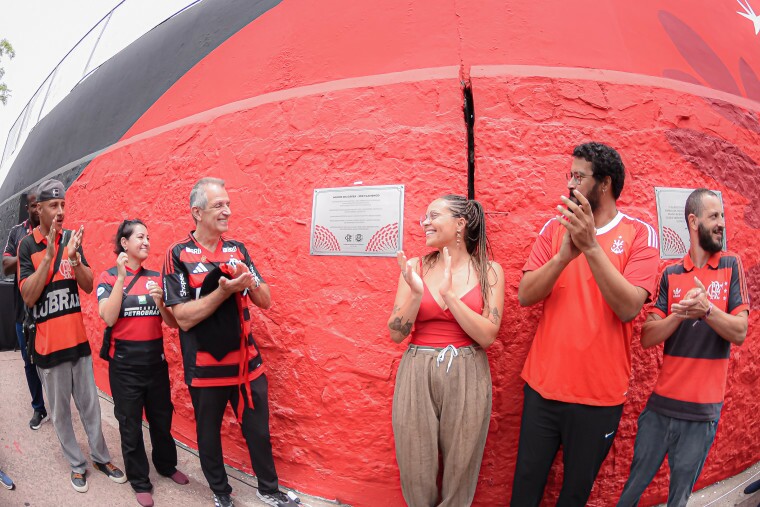
On its 130th anniversary, Flamengo officially inaugurated this Saturday (11/15) the open-air exhibition “Walls of Gávea – Being Flamengo”, which transforms the 274 meters of the wall of the social headquarters, on Rua Mário Ribeiro (Lagoa-Barra), into a large panel of memory, identity and red-and-black culture.
Conceived by president Luiz Eduardo Baptista, BAP, the project was developed by Flamengo's Historical Heritage department, in collaboration with the Negro Muro collective, bringing together six guest artists to reinterpret idols, moments, and symbols that have marked generations.
“Holding this exhibition is a way to share our history, celebrate the symbols and traditions that shaped Flamengo, and honor the Nation. It is also a way to transform the Gávea wall into a space of memory and identity, as well as to give back to the city,” said president Luiz Eduardo Baptista, known as Bap.
The intervention, a striking example of urban art, expresses the mystique and passion of Flamengo in direct dialogue with the city. Made to be seen, experienced, and felt daily, it transforms the landscape of Rio de Janeiro and, once again, allows Flamengo to transcend borders—now, those of its own home. The club begins to tell its story on its own walls, open to the entire population.
Among the featured works is "Mística," by Mateu Velasco, which depicts the most iconic symbol of Flamengo, the vulture, in woodcut print. The strength of the fanbase is represented in the panel "Nação," by Gugie Cavalcanti, which captures the fervor and energy that connect millions of Flamengo supporters inside and outside Rio.
The mural “He vibrates, he is fiber,” from the NegroMuro project, pays homage to iconic figures such as Érica Lopes, the Black Gazelle, and Leônidas da Silva, the Black Diamond, connecting Flamengo to popular culture through dance and funk. The artwork also highlights the eternal Flamengo supporter Ary Barroso, a composer and historical announcer.
Meanwhile, “The Flamengo Jersey and its Red-Black Faith,” by Dolores Esos, celebrates the devotion of the Nation, uniting the symbolic power of the Sacred Jersey with Apolinho's immortal narration of Petkovic's goal, and the faith that has accompanied generations of fans.
Next, the artist Acme presents “Galinho de Quintino, Buck and the Greatest in the World”, placing Zico at the center of the work and also honoring one of the great names in Flamengo rowing, Guilherme “Buck”. Bruno Big brings “The Magnetic Dawn”, a mural that celebrates the club's 130th anniversary, highlighting its origins in rowing, courage, and the boats with indigenous names that marked the beginning of Flamengo's journey.
This collective mural is simultaneously a visual celebration of past and present glories and a testament to Flamengo's cultural influence in Brazil and the world.
Check out each part of the action in detail.
1- Mateu Velasco
Title: Mystic 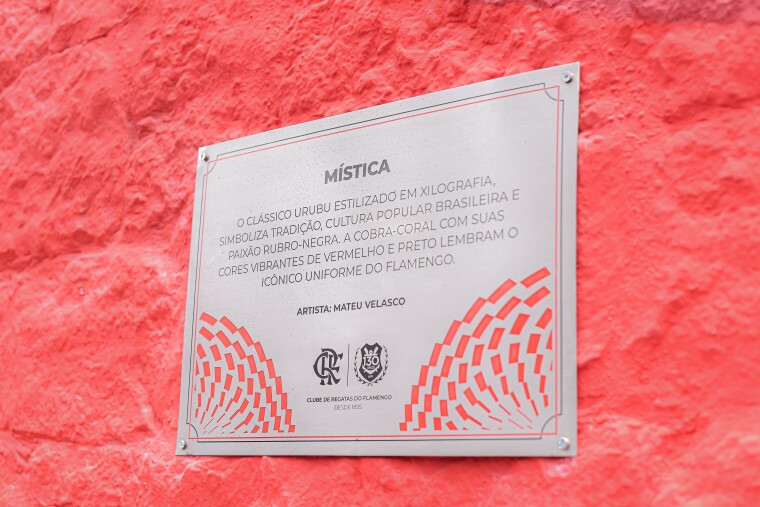
About the artist: Born in 1980, Mateu Velasco graduated in Industrial Design from PUC-Rio in 2003 and holds a master's degree in Graphic Design from the same university. Having drawn since childhood, he began working professionally as an illustrator in 1999.
He expanded his professional career by painting public murals in the early 2000s, developing his own unique language as a visual artist, which can be found on walls and in galleries in São Paulo, Rio de Janeiro, Los Angeles, New York, Paris, and Milan, among other cities around the world.
He currently works in his studio as a visual artist and illustrator, and in parallel paints large-scale murals for festivals and private clients.
The murals painted by the artist were fundamental to the evolution of urban art in Rio de Janeiro, as they brought a unique style of illustration that included a good dose of graphic design – in colors, style, and finish – highlighting his work as an open dialogue between the street and academia, generating a unique language of painting and drawing.
About art: The artwork depicts a majestic vulture, stylized in woodcut, standing imposingly in the center of the scene, referencing the rich tradition of woodcut folk art.
Its open wings are detailed with patterns that evoke the textures of carved wood. In the background, a coral snake slithers sinuously, its vibrant red and black colors reminiscent of Flamengo's iconic uniform, creating a harmonious contrast with the vulture. Subtly hidden among the lines of the woodcut, a small rue leaf emerges, a symbol of luck and protection, representing the indomitable faith of the Flamengo fan in the improbable, in the impossible victories that ignite the passion and enthusiasm of the Magnética (Flamengo's organized fan group).
"Being Flamengo"
"With its wings spread, the vulture embraces every fan - from the favela to the asphalt, from the countryside to the seaside, from inside and outside Brazil."
He asserts himself like the giant he is: guardian of the stands, he flies high claiming the sky, for he knows that fear does not wear the jersey.
An icon of resistance, he transformed provocation into pride. Being Flamengo is not a choice, it's a calling.
It's about having the courage to take flight alongside a nation that doesn't fear the impossible. It's more than just football. It's about culture, identity, and passion.
It's liberation. To be Flamengo is to believe until the very last second that destiny smiles upon you in red and black. Because Flamengo cannot be explained.
Feel free.
It carries
"It is celebrated."
Mateu Velasco
2- Gugie Cavalcanti
Title: Nation
About the artist: Gugie is a Brazilian visual artist, graffiti artist, cultural producer, Black woman, and mother of Lia and Cássia. She holds a bachelor's degree in Visual Arts from the Arts Center of UDESC. Currently, she lives in Rio de Janeiro, returning to her family roots. Her work follows the same path as her life; art and life walk together in her creative impulse, understanding creation as the very possibility of existing. Gugie creates paintings on canvas, large-scale murals, and artistic performances. Her works speak of love between people and how we become sensitive to creating affective relationships. In her studio, she promotes educational and cultural initiatives.
About art: The mural art created by Gugie is a celebration of the passion of Flamengo fans, often referred to as the Nation. The mural, with its striking red and black colors, captures the fiery essence and immortal spirit of the fans who make up the emotional extension of the team. The profusion of details portrays the crowd as a sea moving in unison, each figure contributing to the grand portrait of the Nation, composing a visual symphony that pulsates in sync with the heart of the team.
In the context of world football, Flamengo's fanbase transcends the ordinary, being not just a mass of spectators, but a living entity, almost mystical in its diversity and reach. It is nicknamed "The Nation" for inspiring and uniting millions around a shared passion, transcending geographical and cultural boundaries.
The Flamengo Nation is not just an extension of the team, but a force that often directly affects performance on the field, functioning as a 12th player.
3- BlackWall
Title: He vibrates, he's got fiber!
About the project: NegroMuro was created by researcher and producer Pedro Rajão and artist Fernando Sawaya. The project has established itself as one of the most consistent in the country, transcending its artistic performance on the streets to other platforms such as television series, textbooks, postgraduate thesis topics, lectures, web series, and classroom activities.
Muralism linked to the concept of cartography of Black memory in series makes the project weave various dialogues throughout the city, generating self-reliance.esteem for the community in which it is located your art, in addition to piquing curiosity and belonging to the territory. An art and memory project.
About art: Art begins with the aesthetics of graffiti, with dance, the body in motion, and funk as a Carioca (Rio de Janeiro) identity that is also transnational. We are the biggest in the world!
Next to the clothesline displaying the six-time championship jerseys, appears Érica Lopes, the Black Gazelle, chanted at the top of her lungs by the magnetic crowd, the sprinter who runs smiling, South American record holder, Pan-American bronze medalist, Brazilian and state champion, a very strong female representation in the Flamengo pantheon.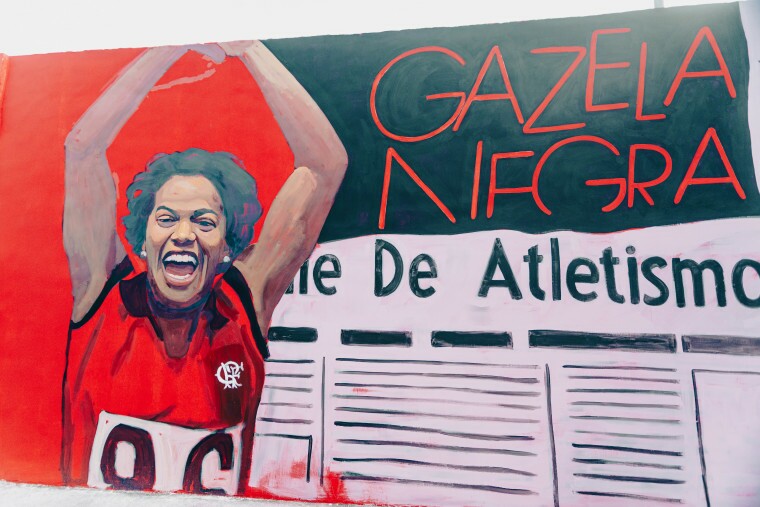
Next up was Ary Barroso, one of Flamengo's most colorful players with his characteristic harmonica, and Leônidas da Silva, incomparable and responsible for 'popularizing' the bicycle kick, the original Black Diamond who 'inspired' the chocolate, an absolute goalscorer with popular charisma.
4- Dolores Esos
Title: The Flamengo jersey and faith
About the artist: Dolores Esos, a visual artist and muralist born in Niterói, studied Fine Arts at UFRJ and graduated in Set Design from UNIRIO. Her art has been featured in solo and group exhibitions. Dolores has had paintings nominated for awards in Brazil, Italy, and the USA. Her style ranges from classical art to graffiti and large murals. Social causes and the figure of strong women are very present in her works.
About art: The central themes of the mural are: the Sacred Mantle (Flamengo's jersey) and Apolinho's historical narration, where the emotion and devotion of Flamengo fans can be heard. The passion and the mystique. The pride and the belief in victory.
On the left side, we can see a close-up of the classic and timeless uniform of a character in a pose that simultaneously evokes the pride that Flamengo fans and players carry in their hearts as they point to the crest crowned with the world championship star. In the same context, there is also a demand for respect and reverence for the club's victorious history from those who come from outside.
In the background, the aesthetic is graphically based on striking, directional, two-tone shapes and large banners, inspired by the art of sports posters and vignettes that evoke clashes, strength, and victories. The word "mantle" itself reinforces this impact that our uniforms have conveyed throughout the years.
On the right side we can see an image of Saint Jude Thaddeus, the team's patron saint, in the background, as if protecting them.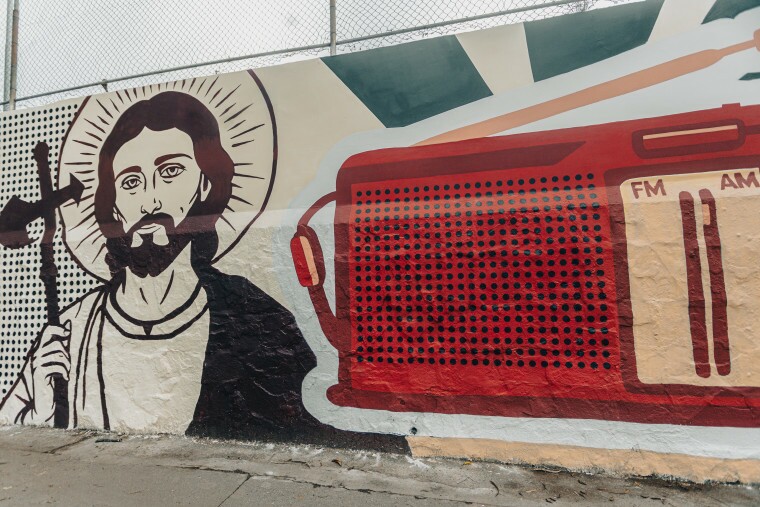
In the foreground, the transistor radio symbolizes Apolinho's epic narration, where we can see a part of this narration quoted in quotation marks, in which he illustrates with words the (mystical) devotion, almost in a reverie, of the seconds before Pet's historic goal in 2001, when he says that even Saint Jude Thaddeus entered the field at that moment to give blessings and good luck at that crucial moment of the game.
5- Acme
Title: Quintino's Little Rooster, Buck, and the Biggest in the World
About the artist: An activist and self-taught artist, also known as "Master Acme," he is internationally renowned for his pioneering work in Rio de Janeiro's graffiti scene; marked by his unique and always innovative style inspired by his urban tropical universe. Currently, in addition to graffiti, the artist creates genuine sculptures using upcycling techniques, addressing the conflicts between human beings and their spirit.
Throughout his career, Acme has created works in various countries and states of Brazil. His art is part of the permanent collection of the National Historical Museum, the Folklore Museum, and the Favela Museum (Rio de Janeiro); the first territorial and living museum about the memories and cultural heritage of favelas in the world, where he is a founding partner, creator, and curator of the "Casas-Tela" circuit; an open-air gallery with paintings on the facades of residents' houses depicting the history of the Pavão, Pavãozinho, and Cantagalo favelas.Creator of the Eagle's Nest Library; which aims to provide access to culture in the favela; through reading and various workshops.
About art: The mural is a striking representation of the essence and energy of the train, the ultimate symbol of Rio de Janeiro's football fans. In the artwork, the train moves to the rhythm of the city and its people, with red symbolizing the blood that gives life to the crowds. Acme vividly captures the unpredictable psychology of the crowd, channeling both the excitement and the harmony that reverberate from the sound of the fans' drums. The art pays homage to the Charanga Rubro-Negra, the club's first organized fan group, led by Jayme de Carvalho, highlighting its pioneering role in the history of Brazilian football.
Centered in the composition, Zico, the greatest legend in Flamengo's history, appears as a focal point that unifies the tribute to the fans. His image translates the passion and devotion of the supporters, considered the club's greatest asset. Zico's presence in the mural symbolizes both his personal legacy and the symbiotic relationship between the players and the Flamengo Nation. This artwork not only celebrates the icon but also highlights the unifying and transcendental power of the fans, emphasizing the collective spirit that makes Flamengo something much bigger than a football and rowing club. And speaking of rowing, we have the image of Buck completing the mural, the coach who revolutionized rowing at Flamengo.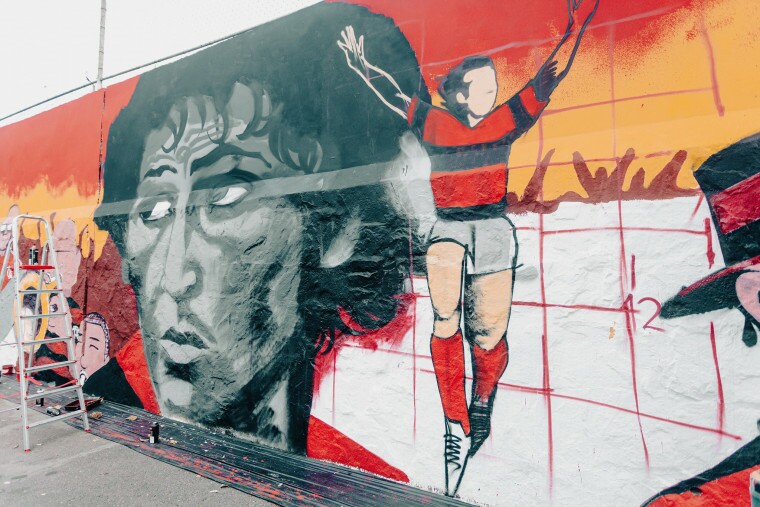
6- Bruno Big
Title: The Magnetic Dawn
About the artist: Bruno Carneiro Mosciaro, better known as Bruno Big, is a multidisciplinary artist born in Rio de Janeiro in 1980. With a striking visual identity, defined by bold lines, expressive gestures, and vibrant colors, his work carries a spontaneity and emotional depth that make it instantly recognizable.
His artistic journey began early and evolved organically. Over the years, Bruno has explored a wide variety of techniques and mediums—from graffiti and large-scale murals to canvas paintings, digital illustration, printmaking, and set design. His ability to move fluidly between the street and the studio, between the figurative and the abstract, has secured him a solid place in the Brazilian—and international—contemporary art scene.
Guided by instinct and a fascination with the unexpected, Bruno has developed a unique visual language over years of research and experimentation. His murals and works have appeared in numerous cities around the world—including Paris, Tokyo, Miami, New York, Amsterdam, São Paulo, and Beijing—transforming walls and public spaces into impactful visual experiences. A staunch advocate for the power of art as a tool for connection, he frequently creates in open urban environments, embracing the energy and rhythm of the streets.
From public murals — such as the one atop the Sugarloaf cable car station in Rio — to intimate paintings produced in his studio, Bruno Big's work is about movement — visual, emotional, and social. His art pulsates with life, inviting the public to connect, reflect, and feel.
It is this blend of curiosity, courage, and creativity that defines him — not only as an artist, but as a force of expression in contemporary Brazilian culture.
About art: The dawn of Clube de Regatas do Flamengo in Lagoa - exploring yellow as the "fourth color" and the dawn of the Republic as a fundamental historical pillar of Flamengo: the club (and not club) initially sporting national colors, has its foundation registered on the same day as the Federative Republic: November 15th, rejecting symbols and remnants of the monarchy, its canoes are by statutory obligation christened with indigenous names.
To celebrate the 130th anniversary of Clube de Regatas do Flamengo, the artwork revisits the beginning of its journey – the moment when it all began. Before the football fields, the packed stands, and the football triumphs, Flamengo was born in the waters of Guanabara Bay, driven by the strength, resilience, and team spirit of young people passionate about rowing.
Rowing was the first sport in which the club excelled, establishing itself as a symbol of determination and unity. It was more than just a sport: it represented the challenge of overcoming the tides and human limitations. Each stroke carried the same impulse that would later guide Flamengo to all its victories – the relentless pursuit of glory.
The proposal is to honor this heroic origin, highlighting rowing as the starting point of Flamengo's identity – a club born from the sea, courage, and collective spirit. Celebrating rowing is remembering that Flamengo has always been more than a team: it's a story of passion and tradition that spans generations.
Technical sheet
Conception and Execution: CRF Teams – Historical Heritage, Communication and Events.
Artistic Curatorship: Marco André Tosatth and Pedro Rajão
Production: Ponte Cultural, Pedro Rajão, Limento Gestão de Eventos and Fla Gávea.
Artists: Mateu Velasco, Gugie Cavalcanti, NegroMuro, Dolores Esos, Acme and Bruno Big.